
Key Takeaways
- More than half of Americans lived paycheck to paycheck in 2025 – and it is not just a low-income problem.
- Budgets most often fail not from lack of willpower, but because they are built on unrealistic rules that ignore real human behavior.
- Small, forgotten expenses – subscriptions, fees, and mindless micro-spending quietly drain finances far more than most people realize.
- Unexpected expenses are inevitable, and any budget that does not account for them is already set up to fail.
- A structured reset – not perfection – is what actually breaks the paycheck-to-paycheck cycle, as discussed later in this post.
If budgeting feels like something that works for other people but never quite sticks, there is a reason for that – and it is probably not what most people think. The problem rarely comes down to discipline or math. More often, the system itself is the issue.
Over Half of Americans Cannot Survive One Unexpected Bill
In 2025, more than 53% of Americans reported living paycheck to paycheck. That means the majority of the country is one car repair, one medical bill, or one missed shift away from a serious financial crisis. What makes this number even more striking is who it includes.
Living paycheck to paycheck is easy to dismiss as a low-income problem. But over 20% of households earning $150,000 or more report the same situation.
High income does not automatically create financial stability, especially when spending increases with every raise.
The paycheck-to-paycheck trap cuts across income levels, and understanding why is the first step to getting out of it.
The emotional toll is just as real as the financial one. Constantly monitoring account balances, dreading unexpected expenses, and feeling like progress is always just out of reach creates a kind of financial anxiety that can wear you down.
At Planning For What Matters we understand and have created financial education resources focused on practical, judgment-free tools. Every tool we build is created to help you get the bottom of your financial issues and crate a realistic path forward.
Budgets Fail Before They Begin
Most budgets do not collapse in month three. They fail on day one – before a single dollar is tracked.
Budgets Feel Like Punishment
The biggest reason people abandon budgets isn’t because of lack of effort.
The mindset behind the budget is the problem.
When a spending plan reads like a list of things that you can’t have or can’t do, the brain treats it as you being deprived, and deprivation, over time, triggers rebellion.
Financial experts consistently point out that budgets built around restriction rather than intention are psychologically unsustainable.
People do not fail budgets. Budgets fail people.
Unrealistic Rules Make It Impossible To Stick With
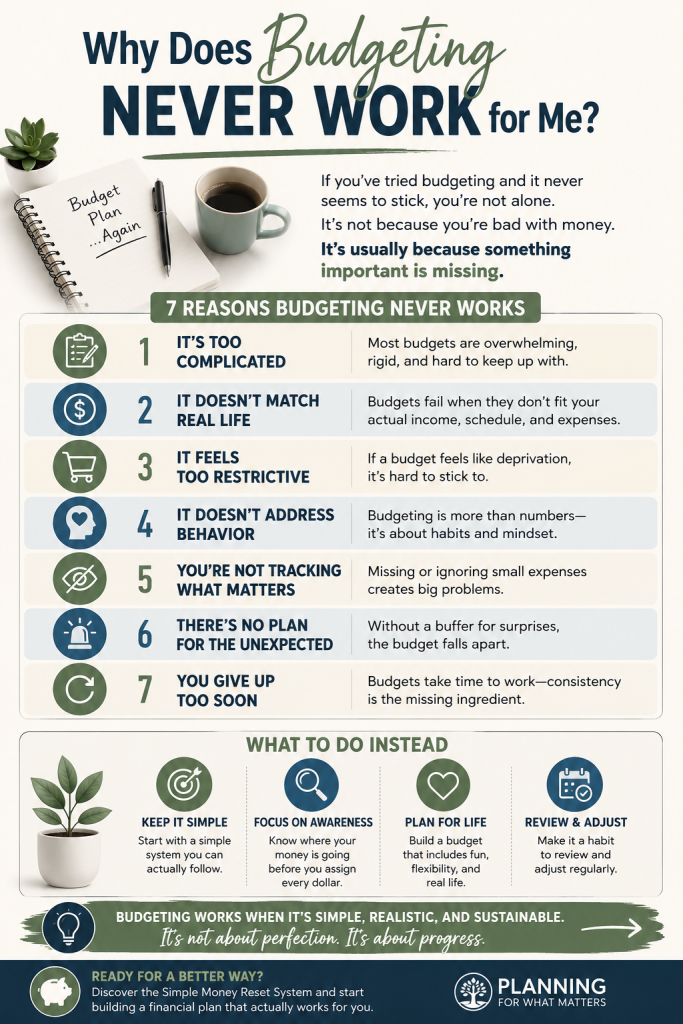
Setting spending limits that do not reflect real life is one of the most common budgeting mistakes.
A plan that assigns $200 for groceries when a household consistently spends $400 is wishful thinking, not a workable budget.
When the numbers do not match reality, the first overage feels like you’ve failed and once that failure sets in, abandoning the whole plan becomes easy.
Behavioral economics describes this as the what-the-hell effect: one slip leads to throwing the entire plan out the window.
Most traditional budgeting methods also tend to ignore the emotional side of money decisions.
Stress, boredom, celebration, and habit all drive purchases. A budget that does not account for human behavior is working against itself from the start.
Hidden Money Leaks Are Draining You Daily
Even when someone is actively trying to manage money, small expenses have a way of slipping through unnoticed. These are often called money leaks – each one on it’s own is minor, but over the course of a month they can be really damaging to your finances.
These are the first steps to take today to start getting more control of your finances…
Forgotten Subscriptions and Fees
Streaming services, app subscriptions, gym memberships, cloud storage plans – these charges often get set up once and forgotten entirely.
A $9.99 charge here, a $14.99 charge there, and suddenly $60 to $100 a month is leaving a bank account without a second thought.
Add in bank fees, late payment fees, and unnoticed credit card annual fees, and the total monthly drain from forgotten recurring charges can be massive.
These charges are designed to be frictionless – easy to sign up for, easy to forget, and easy to overlook on a statement that shows 40 or more transactions in a month.
Mindless Micro-Spending Adds Up Fast
A $4 coffee on Monday. A $7 lunch on Tuesday. A $12 impulse buy on Thursday. Each purchase feels harmless on its own. But micro-spending – small, frequent purchases that happen almost automatically, adds up quickly when left untracked.
This is not about cutting out every small pleasure. Awareness is the point.
Most people who start tracking their daily spending are genuinely surprised by where the money goes, and knowing where your money is really going is the first step to making positive financial changes.
You don’t have to go without, but understanding where your money is going and deciding what is important and what isn’t, is step one to taking control of your money.
Unexpected Expenses Break Every Plan
Even a well-designed budget can fall apart when life happens. Car trouble, a medical copay, a broken appliance, a last-minute trip for a family emergency – these are not rare events. They are normal parts of life that arrive on unpredictable schedules.
Budgets that only account for fixed and expected expenses have a structural flaw built in from the start.
When an unexpected expense hits – and it will – there is no room for it.
The budget breaks, frustration sets in, and the whole system gets abandoned.
Building a financial cushion for the unexpected is not optional.
Without it, every budget is just one bad month away from collapse.
Financial Blind Spots Keep You Stuck
Avoiding Your Finances Makes It Worse
One of the most common responses to financial stress is avoidance, skipping the bank statement, putting off checking the credit card balance, ignoring the alerts.
It’s natural to want to avoid the pain and fear associated with seeing your financial situation in black and white, but it’s also just leading to more of the same.
That avoidance feels like relief in the moment, but it creates financial blind spots, and blind spots are where small problems grow into serious ones.
An unnoticed subscription quietly charges for eight months.
A minimum payment gets missed.
A bank fee compounds.
None of these are catastrophic on their own, but together they create a financial picture that is much harder to untangle than it needed to be.
Checking in regularly, even just a few minutes a week, prevents minor issues from becoming major setbacks. The discomfort of looking at the numbers is almost always less painful than the consequences of not looking.
A Simple Reset Can Break the Cycle
Breaking the paycheck-to-paycheck cycle doesn’t require a financial overhaul or giving up everything you enjoy.
Two simple moves can start the process…
Stop the Leaks First
Before building any kind of forward-looking budget, the first priority is identifying what is already draining money without you being aware of it.
Checking for forgotten and unused subscriptions, reviewing recurring charges, and tracking spending for even two or three weeks creates immediate clarity.
Most people find savings they didn’t know they had – money that was quietly leaving for things they had totally forgotten about and don’t want or use.
This step alone can free up $50 to $150 per month for many households – which may not sound like a lot but that’s money you’ve already been spending, you’ve just been spending it without realizing it.
Think of what that money would do if you redirected into a savings account or to pay down your credit cards.
Build a Budget That Reflects Real Life
The goal is a realistic budget, not a perfect one.
Having a realistic budget means using actual spending history rather than hopeful numbers, building in a buffer for unexpected expenses, and leaving room for things that you enjoy.
A budget that is too strict will be difficult to stick with. A budget that is honest and flexible tends to stick.
Simple tools – an expense tracker, a subscription audit sheet, a weekly check-in habit – make this dramatically easier.
The system matters more than the willpower.
When the right structure is in place, staying on track becomes the path of least resistance rather than an ongoing act of discipline.
You Do Not Need to Be Perfect – You Need a System That Works
Financial stability is built by people who have a system forgiving enough to recover from mistakes – not by people who never make mistakes.
The paycheck-to-paycheck cycle, hidden money leaks, and budget failures all share a common root: trying to manage money without a clear, realistic framework.
Progress compounds – stopping one money leak leads to noticing another.
A small buffer grows into an emergency fund. An emergency fund reduces financial anxiety, reduced anxiety makes staying on track easier.
The negative money cycle can also run in reverse – but it starts with a single honest look at where things actually stand today, not where you hope they’ll be.
For anyone ready to take that first step, our Money Reset System offers straightforward, easy to use tools and guidance that takes you from out of control finances to knowing exactly where your money is going. It’s designed to help you build lasting financial stability.